

What is endotoxin in hemodialysis? Critical Risk for Patient Safety
February 17, 2026
Single Pass or Double Pass? – Making the Right Decision in Hemodialysis Water Purification Systems
February 18, 2026
Microorganisms do not live alone in nature. When suitable surface and environmental conditions arise, they form organized structures. These structures can pose serious risks in both the healthcare sector and industrial areas.
So, What is Biofilm? Why is it so important, and why is it a critical issue, especially in medical device manufacturing? In this article, we will discuss the formation mechanism of biofilm, its effects on health, and prevention strategies in detail.
Definition of Biofilm
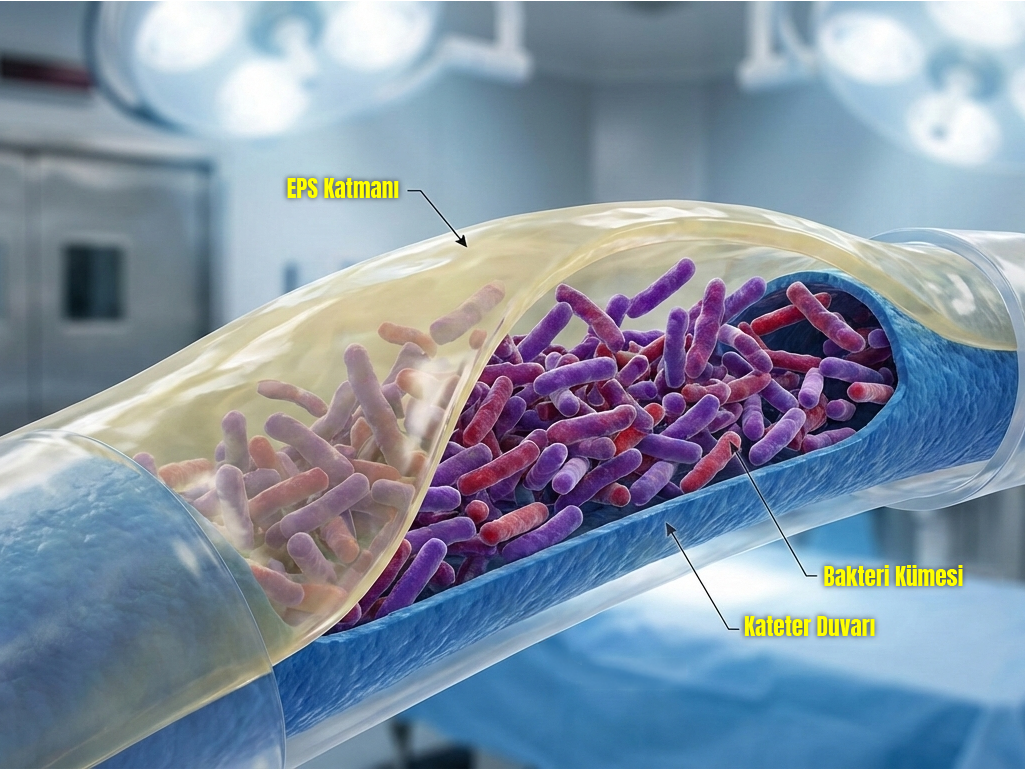
What is Biofilm? In its simplest definition, biofilm is a microbial community formed by bacteria, fungi, or other microorganisms adhering to a surface, organized within a protective, adhesive matrix. This structure enables microorganisms to develop resistance to environmental stresses. Once biofilm forms, microorganisms become significantly more resilient than their free-living, planktonic counterparts. Consequently, biofilm structures are among the most challenging microbial organizations to combat in infection control.
How Was Biofilm Discovered?
For many years, it was believed in the scientific community that bacteria lived as free-floating cells. However, microscopic examinations revealed that microorganisms adhere to surfaces and form colonies. At this point, the question was asked again: What is Biofilm? Research has shown that bacteria mostly live in biofilm form.
Why is Biofilm Dangerous?
Biofilms show high resistance to antibiotics and disinfectants. This is because cells produce a protective matrix called extracellular polymeric substance (EPS). This matrix makes it difficult for chemical agents to penetrate. Therefore, the question “What is Biofilm?” is not just theoretical, but also a vital clinical question.
How Does Biofilm Form?
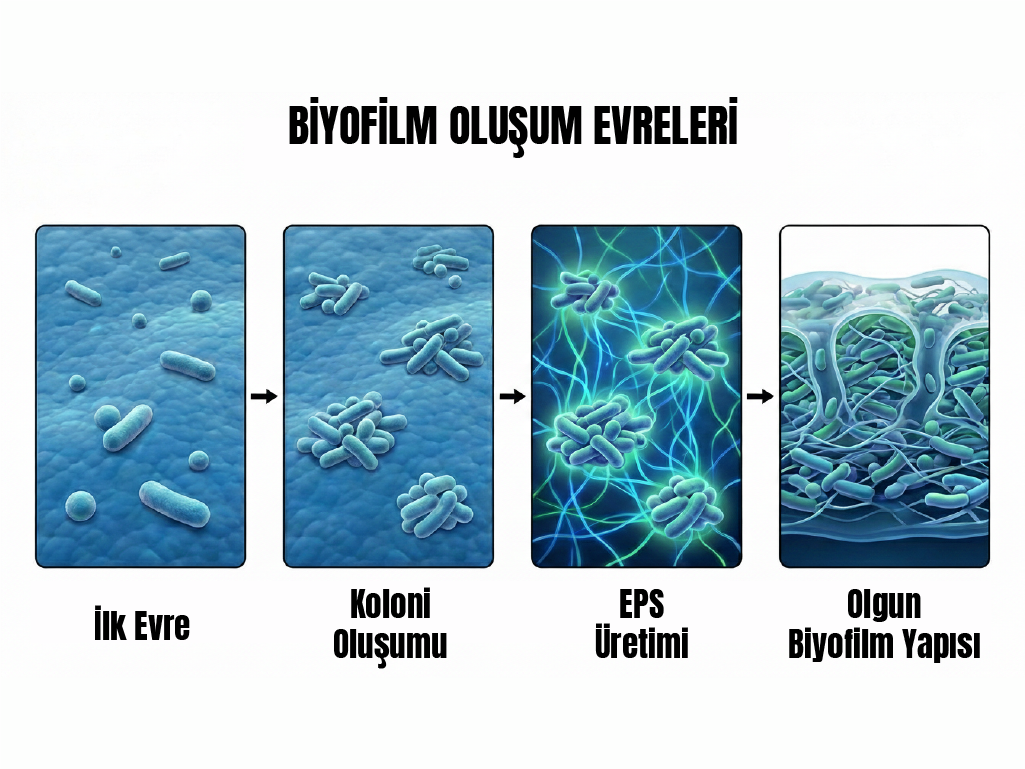
Initial Adhesion Stage
Microorganisms first temporarily adhere to a suitable surface. This surface can be a catheter, implant, water pipe, or stainless steel. Initial contact is weak; however, if conditions are suitable, permanent bonding occurs.
Microcolony Formation
Adhered cells begin to multiply. Intercellular communication (quorum sensing) mechanisms are activated. At this stage, it is necessary to return to the question: What is Biofilm? It is no longer just a few cells, but an organized community.
Extracellular Polymeric Substance (EPS) Production
Microorganisms produce a sticky matrix composed of polysaccharides, proteins, and DNA. This structure is the primary defense line of the biofilm. Thanks to EPS, the biofilm structure is protected against physical and chemical effects.
Mature Biofilm Structure
At this stage, the biofilm acquires a three-dimensional architecture. Oxygen and nutrient distribution differ in the inner parts. This heterogeneous structure strengthens treatment resistance mechanisms.
Biofilm Dispersal and Spread
Cells detaching from mature biofilm are transported to other surfaces and form new colonies. This plays a critical role, especially in the spread of hospital infections.
Where is Biofilm Found?
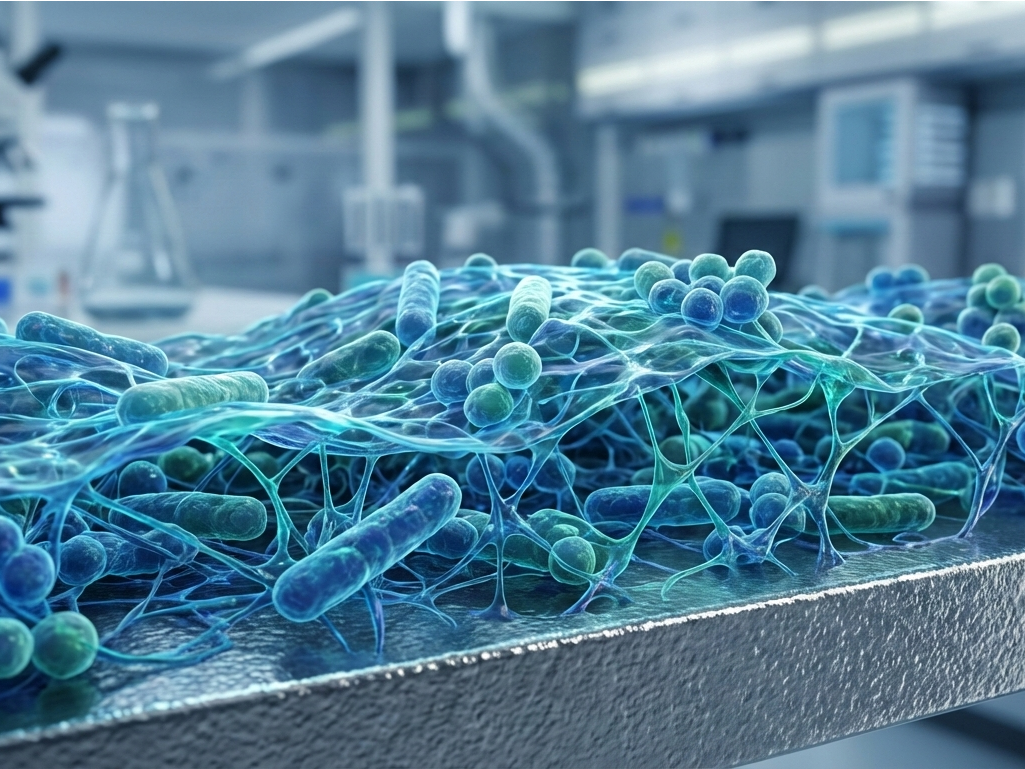
Hospitals and Medical Devices
Catheters, prostheses, implants, and surgical instruments are at risk for biofilm formation. Especially in invasive devices, biofilm can lead to chronic infections.
Catheters and Implants
Devices that remain in the body for a long time have a high risk of biofilm development. At this point, the question becomes important again: What is Biofilm? Because it can be one of the main reasons behind device failure.
Industrial Water Systems
Cooling towers and water pipelines are suitable environments for biofilm formation. This reduces equipment performance and can cause corrosion.
Food Production Facilities
In the food industry, biofilm is a serious threat to hygiene. Inadequate cleaning protocols can lead to contamination.
In Daily Life: Dental Plaque
Plaque formed on the tooth surface is actually an example of biofilm. This example is the everyday equivalent of the question, “What is Biofilm?”
Effects of Biofilm on Health
- Antibiotic Resistance: Bacteria within biofilm can be 10 to 1000 times more resistant to antibiotics.
- Chronic Infections: Wound infections, urinary tract infections, and implant infections are associated with biofilm.
- Healthcare-Associated Infections: A significant portion of nosocomial infections are biofilm-related.
How to Prevent Biofilm?
- Regular and correct cleaning protocols
- Sterilization and disinfection methods
- Antimicrobial surface coatings
- Surface design and material selection
- Mechanical cleaning and physical removal
Biofilm Control in Medical Devices
- MDR and biocompatibility tests
- Cleaning and sterilization validation
- ISO 14971 risk analysis
Biofilm is not only a microbial structure but also a serious clinical risk factor.
The Most Effective Approach in Combating Biofilm
- Surface optimization
- Effective sterilization
- Continuous hygiene control
- Chemical + mechanical + design multi-layered protection
Future Biofilm Control Technologies
Nanotechnology-based coatings, smart surfaces, and biofilm detection sensors will become more common in the future.
Reduce Biofilm Risk in Hemodialysis Water Purification Systems
In hemodialysis units, water quality is one of the most critical elements for patient safety. Biofilm formation in inadequately controlled water systems can lead to increased endotoxins, microbial contamination, and decreased device performance.
We establish infrastructures compliant with international standards using reverse osmosis (RO) systems, ultrafiltration modules, endotoxin-retaining filters, and stainless steel loop designs.
You can keep your systems under continuous control with periodic maintenance, disinfection planning, and microbiological analysis support. hemodialysiswaterpurification.com