

Hemodialysis Water Purification Systems (Double Pass)
Ultra Pure Water Solutions
Ultra Safety, Double Barrier, Maximum Patient Protection
The quality of water used in hemodialysis treatment is directly related to patient safety. During dialysis, the patient’s blood comes into contact with large volumes of water; thus, even the smallest chemical, microbiological, or pyrogenic contamination in the water can pose serious clinical risks. For this reason, sustainable and high-security purification solutions that comply with international standards are critically important.
Double Pass Reverse Osmosis systems provide maximum purification by passing water through two separate membrane stages. Water largely purified in the first pass is reprocessed in the second stage, minimizing conductivity, total dissolved solids (TDS), bacterial, and endotoxin levels. This double barrier approach stands out as one of the most reliable solutions, especially for risky water sources.
In Which Cases is a Double Pass System Mandatory?
Well Water Usage (Most Common Choice):
Well water has a more challenging structure compared to standard tap water due to its high mineral content, variable conductivity values, and potential microbiological load. This variability can lead to performance fluctuations in single-pass systems. Double Pass systems, with their two-stage purification, offer maximum stability and safety against the unpredictable nature of well water.
Water with High Conductivity and TDS Values:
In areas with high total dissolved solids (TDS) ratios, single-pass systems may struggle to reduce water to dialysis standards. With Double Pass technology, conductivity values are brought down to near-zero levels, maximizing chemical purity. This provides a significant advantage, especially for sensitive patient groups.
Sources with Microbiological Risk:
The double membrane structure doubles bacteriological safety. Microorganisms or endotoxin particles that might pass the first stage are completely retained in the second stage. Thus, the system creates a strong safety barrier in centers requiring ultra-pure water.
Sources with Seasonal Variability:
In regions where water parameters do not remain stable throughout the year, Double Pass systems act as a reliable buffer. Sudden changes in inlet water are not reflected in the quality of the outlet water, thus ensuring continuous and standard-compliant production.
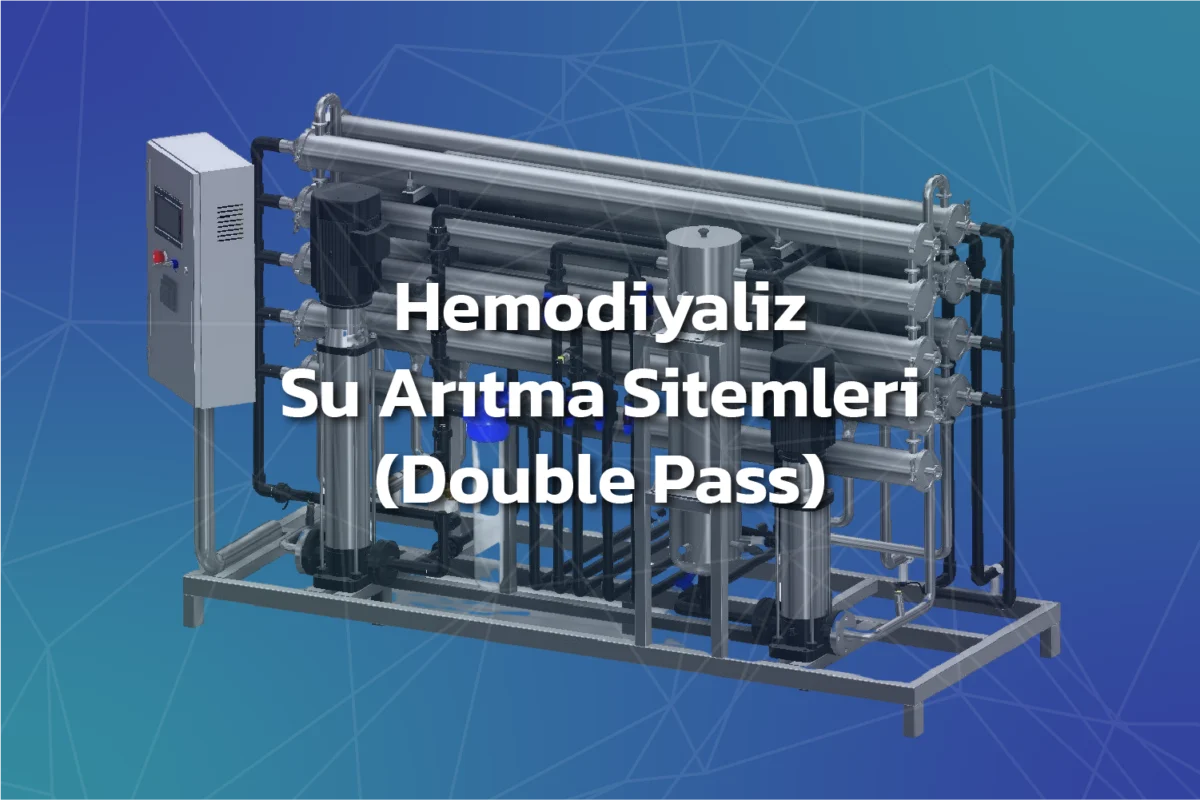

Technical Advantages
Maximum Water Safety
Thanks to the redundant membrane structure, endotoxin and microbial risks are minimized. This structure provides a high level of protection for patient safety.
System Redundancy and Operational Continuity
Even if one stage is disabled due to maintenance or malfunction, emergency operation can be continued with the other stage. This feature offers a critical advantage for the uninterrupted continuation of dialysis services.
Ultra-Pure Water Quality
Chemical and microbiological purity beyond standards is achieved. The outlet water quality is at an ideal level for hemodialysis applications requiring high safety.
Double Pass Hemodialysis Water Purification Systems are designed to meet the high standards of modern dialysis centers by offering reliability, continuity, and ultra-pure quality. Especially in healthcare facilities with challenging water sources, it is a powerful and sustainable solution that provides the highest level of patient safety.
Smart Operation Management – Near-Zero Human Error
Double Pass Hemodialysis Water Purification Systems are designed to meet the high standards of modern dialysis centers by offering reliability, continuity, and ultra-pure quality. Especially in healthcare facilities with challenging water sources, it is a powerful and sustainable solution that provides the highest level of patient safety.