
Dialysis softener hardness breakthrough occurs when calcium and magnesium at the softener outlet exceed the defined control criterion. Possible causes include exhausted operating capacity, ineffective regeneration, uneven flow through the resin bed or untreated water mixing into the softened supply. Prevention requires more than adding salt. Feedwater analysis, actual consumption, regeneration records and outlet hardness measurements must be assessed together. Acceptance criteria should reflect the RO manufacturer’s feedwater requirements and the facility’s approved procedure.
The softener is a pretreatment component that helps protect reverse osmosis membranes against hardness-related deposits. Unrecognized dialysis softener hardness breakthrough can affect RO operating performance. However, softened water is not automatically suitable for dialysis; other chemical and microbiological controls remain necessary. For Reinmeer Water Treatment Systems, an appropriate technical assessment should consider pretreatment, RO equipment and facility operating conditions as connected parts of the installation.
What Are the Likely Causes of Hardness Breakthrough?
The timing of a failed result helps organize an investigation. Hardness rising near the end of the operating day differs from an unacceptable result immediately after regeneration. A problem appearing only during high demand also raises hydraulic questions. When investigating dialysis softener hardness breakthrough, record sampling time, the active vessel, processed volume and the latest regeneration event together.
Total hardness, conductivity and total dissolved solids are different measurements. Sodium-form softening resin exchanges hardness ions for sodium rather than removing all dissolved salts. Normal conductivity therefore cannot establish acceptable outlet hardness. Begin the investigation with an appropriate total hardness measurement instead of relying on water appearance or an unrelated operating display.
Insufficient resin capacity and an incorrect regeneration programme
Selecting resin volume from vessel diameter alone is insufficient. Feedwater hardness, daily throughput, instantaneous flow and regeneration conditions determine usable performance. Published total exchange capacity is not the same as available operating capacity. Use the resin manufacturer’s data for the relevant salt dose and working conditions, with an appropriate reserve established through the design assessment.
A useful first calculation for dialysis softener hardness breakthrough prevention is the daily hardness load. For example, water at 250 mg/L as CaCO3 passing through the softener at 8 m³/day represents 2,000 grams of CaCO3-equivalent load per day. This is an illustrative load calculation, not a sizing recommendation. Resin volume, usable capacity and reserve require separate evaluation.
Using only RO product water volume can underestimate the pretreatment load. Depending on recovery, RO feed demand can be greater than product output. Include other consumers supplied through the softener and relevant regeneration water demand. Adding dialysis stations or extending operating hours can make an existing capacity setting unsuitable even when the original installation performed satisfactorily.
Time-based regeneration may not represent variable consumption adequately. Meter-controlled arrangements depend on accurate flow measurement, correct feed hardness settings and suitable reserve capacity. If some flow bypasses the meter, the controller can overestimate remaining capacity. Dialysis softener hardness breakthrough may therefore reflect an instrumentation or programming problem rather than a need to replace the resin immediately.
Water softener regeneration can include backwashing, brine draw, rinsing and brine tank refill, depending on the equipment. A completed sequence does not independently establish effective treatment. Required pressure, flow and drainage conditions should be verified. Operators should not change salt dosage or cycle durations arbitrarily; adjustments need to follow the equipment instructions and technical assessment.
If hardness is acceptable immediately after regeneration but the service run is unexpectedly short, review feedwater changes, consumption and capacity settings. If the first post-regeneration result is already unacceptable, investigate brine contact, valve operation and resin condition. This distinction helps target the investigation of dialysis softener hardness breakthrough and reduces reliance on repeated regeneration without understanding the cause.

Resin age alone does not determine replacement. Fouling, physical condition and service history require technical evaluation. The Purolite sodium-cycle resin engineering bulletin discusses the relationship between performance, flow and regeneration conditions. Its product-specific data should not be transferred directly to a different resin or every dialysis installation.
Brine tank, injector, control valve and channeling problems
Visible salt does not prove that suitable brine reaches the resin. A salt bridge can leave an apparently adequate dry layer above water that is not contacting sufficient salt. Refill faults, blocked lines or poor brine draw can produce similar symptoms. Evaluate actual filling and draw behaviour alongside the observed salt level.
The injector helps draw brine under the required hydraulic conditions. Obstruction, incorrect component selection or air entering a connection can interfere with this function. Dialysis softener hardness breakthrough should not automatically be attributed to exhausted capacity. A qualified service team should assess the relevant pressure and flow conditions using the manufacturer’s procedure, without improvised dismantling of pressurized equipment.
The control valve directs service and regeneration flows. Worn internal seals, distributor problems or an open bypass can allow untreated water into the outlet. The Pentair control valve service manual includes bypass, salt supply, injector and distributor checks when investigating hard water complaints.
Channeling means water follows preferential pathways instead of contacting the resin bed evenly. Investigate bed arrangement, distributors, backwash conditions and unsuitable operating flows. Excessive flow is not the only possibility; poor distribution can also occur under some low-flow conditions. Use the resin manufacturer’s working range when assessing the installed vessel and its actual service pattern.
To investigate dialysis softener hardness breakthrough, compare outlet hardness with flow, pressure behaviour and regeneration history. No single pressure reading establishes resin condition. Sampling also needs care: a sample collected after an unrecognized mixing connection can conceal vessel performance or suggest a fault in the wrong component. Confirm the current flow diagram before interpreting results.
The following matrix links observations with investigation priorities. Similar symptoms can arise from different faults, so it provides a review framework rather than a definitive diagnosis.
| Observation | Possible cause | Review focus |
|---|---|---|
| Hardness rises late in the day | Insufficient usable capacity | Feed hardness and throughput |
| Hard outlet after regeneration | Inadequate brine contact | Draw, refill and cycle evidence |
| Failure during high demand | Hydraulic overload or poor distribution | Vessel flow and bed conditions |
| Persistent or irregular mixing | Bypass or internal valve leakage | Valve configuration and integrity |
How Can Reliable Hardness Control Be Established?
A reliable programme connects a representative sample, a sufficiently sensitive test and a defined response. For dialysis softener hardness breakthrough, acceptance criteria should satisfy RO feedwater requirements. Document the method, sampling points, record format, events requiring additional checks and the actions to take when a result is unacceptable.
The CMS dialysis facility survey guidance addresses testing total hardness at the softener outlet at the end of each treatment day, recording results and ensuring sufficient test sensitivity for the RO manufacturer’s requirements. This US reference does not replace local regulations, applicable standards or manufacturer instructions in another jurisdiction.
Sampling point, measurement frequency and alarm response
Use a defined sampling point representing softened outlet water. Feedwater measurements help assess changing hardness load, while individual vessel outlets help identify which unit is affected. When sampling a common outlet, record the active vessel and valve arrangement. Pre-RO hardness monitoring should be linked to the actual pretreatment layout rather than an assumed standard configuration.
Monitoring should not depend exclusively on an early-morning result. End-of-day measurements help assess conditions after daily capacity consumption. Regeneration, vessel changeover, maintenance, feedwater changes and previous failures can justify additional checks. The timing of these checks for dialysis softener hardness breakthrough should follow manufacturer instructions and the facility’s approved risk assessment.
Suitable total hardness methods can include titration, appropriate test strips or another validated method. The range and sensitivity must support assessment against the acceptance criterion. Avoid confusion between mg/L as CaCO3, ppm and grains per gallon. Where conversion is necessary, document the basis and ensure results and alarm settings are compared using compatible units.
Check reagent expiry, storage conditions and reading instructions. Contaminated sample containers or incorrect reading times can affect interpretation. A result recorded as zero must also be understood against the method’s detection capability. For dialysis softener hardness breakthrough records, an actual result and identified method are more informative than an unexplained pass or fail box.
An automatic hardness analyser does not eliminate the need for verification. A blocked sample line, exhausted reagent or instrument fault can give misleading reassurance. Follow maintenance requirements and compare performance with a suitable reference method. Confirm that alarms reach the responsible team and that the defined response functions under the intended operating conditions.
When hardness is unacceptable, review sampling and test accuracy while applying the approved protective response. Dialysis softener hardness breakthrough procedures can include notification, transfer to a verified alternative vessel or prevention of unsuitable RO feed. The specific arrangement depends on the installation. Operational and clinical decisions belong to the responsible facility team; protective interlocks should not be bypassed informally.
Expert note: A hardness result assesses softening performance. It does not replace chlorine or chloramine monitoring, RO product water analysis or microbiological surveillance. One acceptable pretreatment result cannot establish that every dialysis water safety requirement has been met.
Duplex softening and simultaneous flow planning
A duplex arrangement uses two vessels under a defined operating sequence. One may supply softened water while the other regenerates or remains available. With suitable design, this can support continuity. However, two tanks alone are insufficient. Dialysis softener hardness breakthrough prevention also requires verification of changeover conditions, remaining capacity and the readiness of the alternative vessel.
In an alternating arrangement, each vessel should meet the required service flow while operating alone. In a parallel arrangement, demand is shared, so available performance must be reassessed when one vessel regenerates. These configurations are not interchangeable. Establish how suitable water will be supplied during regeneration before relying on the total nominal capacity of both vessels.
Assess simultaneous RO feed demand, auxiliary consumption and regeneration water requirements together. Daily volume does not establish instantaneous flow. Dialysis softener hardness breakthrough can occur during peak demand even when the calculated daily capacity appears adequate. The control valve, vessel cross-section and resin bed must operate within appropriate hydraulic conditions.
Review controls intended to prevent unsuitable simultaneous regeneration or transfer to an unverified vessel. Pressure and flow during changeover also matter. Follow manufacturer maintenance and hygiene requirements for standby equipment. Duplex softening is a configuration that needs verification, not a substitute for testing, maintenance or a documented response to abnormal conditions.
When assessing single-pass dialysis RO systems or double-pass RO solutions, review pretreatment conditions as well. Adding a second RO stage does not make unsuitable hardness at the first stage acceptable. Equipment selection should consider feedwater analysis and simultaneous demand alongside the required product output.
Traceable Records for Dialysis Softener Hardness Breakthrough Control
Keep an updated flow diagram, sampling locations, vessel details, regeneration settings and acceptance criteria in the control file. Daily records should identify time, active vessel, hardness result and any intervention. Shift handover should include remaining capacity and unresolved issues, so essential operating information does not depend on one person’s recollection.

For repeated dialysis softener hardness breakthrough, compare measurements with consumption and regeneration history. Continuing with old settings after feedwater changes, or increasing regeneration frequency to compensate for an unrecognized meter fault, may leave the cause unresolved. Following corrective action, verify both post-regeneration suitability and performance across the intended service period.
Frequently Asked Questions
What hardness is acceptable at the softener outlet?
Use the RO manufacturer’s feedwater requirements and the approved facility procedure. Do not apply one unsupported value to every installation. The selected test must be sensitive enough to assess the relevant criterion.
Why can hardness break through when salt is still present?
A salt bridge, refill problem, failed brine draw or valve fault can prevent effective regeneration. Visible salt alone does not confirm performance. Compare cycle behaviour with outlet hardness results.
When should pre-RO hardness be tested?
End-of-day checks help assess consumed capacity. Additional testing may be needed after regeneration, changeover, maintenance or failure. Establish the programme using applicable requirements and manufacturer instructions.
Can conductivity replace a total hardness test?
No. Softening exchanges ions instead of removing all dissolved salts. An acceptable conductivity result does not prove sufficiently low hardness. Use a separate method suitable for total hardness measurement.
Does duplex softening completely prevent breakthrough?
No. Effective regeneration, correct sizing, reliable changeover and regular testing remain necessary. If one vessel cannot meet service demand during regeneration, having two tanks does not independently resolve that limitation.
Review Your Pretreatment Requirements with Reinmeer
If your facility experiences dialysis softener hardness breakthrough or needs pretreatment planning for a new installation, discuss the assessment with Reinmeer Water Treatment Systems. Prepare feedwater analysis, daily consumption, peak flow information, the RO model and softener specifications. Recent hardness measurements and regeneration records can help distinguish capacity limitations from hydraulic or equipment-related problems.
Explore hemodialysis water treatment solutions to request information, discuss a site assessment or define a quotation scope. For an existing installation, review sampling coverage and improvement priorities. For a new project, consider usable resin capacity and simultaneous demand together. When discussing technical support options, explain when failures occur and which vessel is operating. Include planned station expansion, longer operating hours or a change in water source. The proposed solution should be defined around manufacturer requirements, site findings and the responsible facility team’s evaluation.
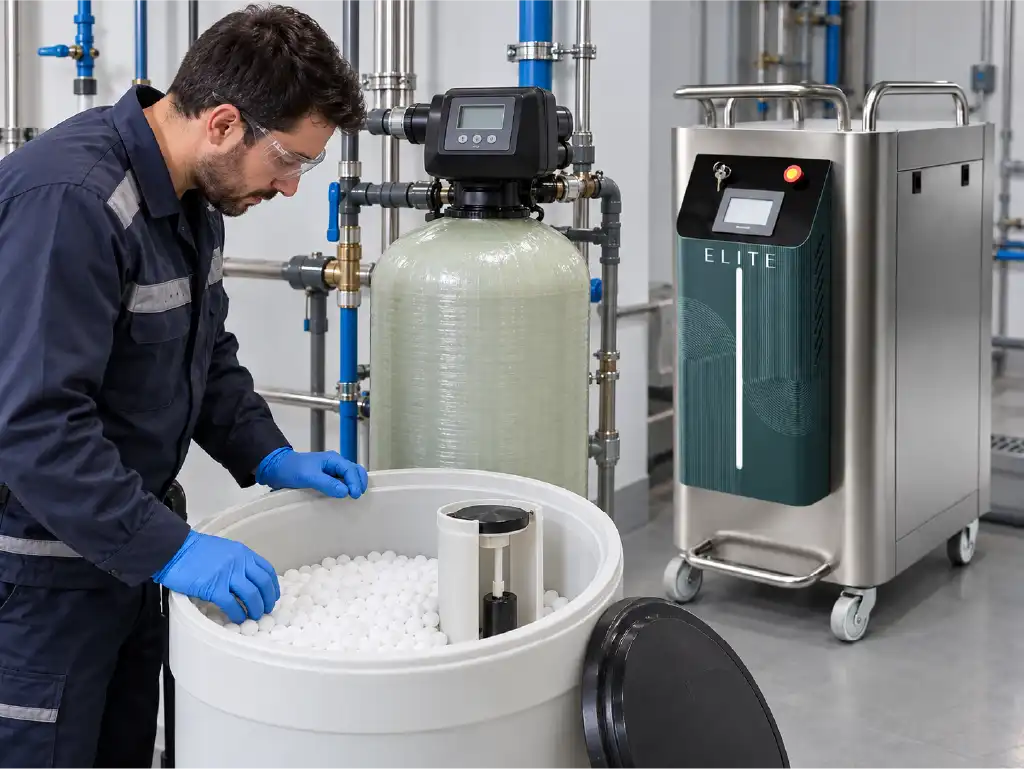
Images are illustrative and have been generated using artificial intelligence.