
Dialysis water system alarm limits should be established using feedwater analysis, verified equipment performance, manufacturer instructions and a facility-specific risk assessment. A conductivity setting copied from another installation is insufficient. The measurement location, sensor accuracy, operating mode and protective response also matter. Effective monitoring connects a reliable measurement to a defined action, with clear responsibility for investigation and return to service.
One facility may need to investigate rising product conductivity; another may experience inadequate circulation or unstable supply pressure. Consequently, dialysis water system alarm limits belong in a documented operating plan rather than an isolated settings screen. When assessing a Reinmeer Water Treatment Systems project, consider pretreatment, RO capacity, distribution piping, monitoring instruments and support requirements together.
Which Parameters Should Be Monitored Continuously?
Continuous monitoring should cover measurements that represent water quality and equipment condition. Typical candidates include feed and product conductivity, production flow, relevant pressures, temperature and tank level where a tank exists. Instrument selection must reflect the actual hydraulic arrangement. Every monitored value needs an identified location, engineering unit, operating range and verification method.
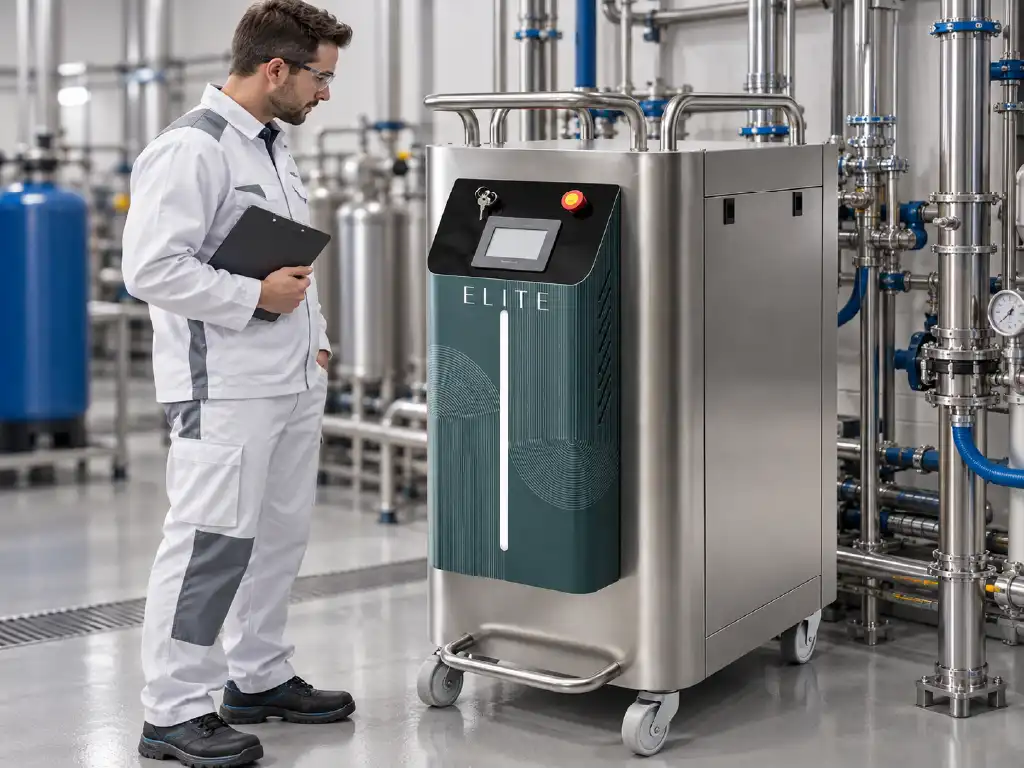
Normal production, startup, standby, disinfection and return to service require separate consideration. A temperature expected during a validated thermal disinfection cycle may be unacceptable during water delivery. Dialysis water system alarm limits must therefore be linked to operating modes without allowing mode changes to conceal a genuine fault. Access to those settings should be controlled.
Conductivity, flow, pressure, temperature and tank level
Conductivity helps track the combined contribution of dissolved ions. Increasing product conductivity may indicate changing feedwater, membrane deterioration, a connection problem or an instrument error. A conductivity alarm does not identify individual contaminants and does not measure bacteria or endotoxin. An acceptable reading alone cannot demonstrate compliance with every chemical and microbiological water-quality requirement.
Temperature compensation and reference conditions must be documented before readings are compared. An apparent ionic rejection trend can support RO performance assessment when feed and product measurements are taken under compatible conditions. Measurement uncertainty becomes particularly important at low feed conductivity. This calculation should not be presented as a removal guarantee for all contaminants.
Flow monitoring should distinguish RO production from circulation through the distribution loop. Depending on the design, feed, product, concentrate and return flows may all be useful. Reduced production and inadequate loop return are different events. Dialysis water system alarm limits should account for simultaneous equipment demand, operating temperature and pump condition before a capacity change is interpreted as a fault.
Pressure measurements help identify conditions at pump suction, membrane feed and distribution points. Differential pressure across a filter can indicate increasing resistance, but its interpretation depends on flow. High pressure, low pressure and an invalid transmitter signal should have separate definitions. Their protective responses may differ because they affect equipment integrity and water availability in different ways.
Temperature monitoring supports performance assessment and control of the specified disinfection process. Where tanks are included, low level, overflow risk and inconsistent level signals need attention. Low-level protection may prevent dry running. A direct-feed installation without a tank needs protection based on its actual hydraulic risks rather than a copied tank-level alarm configuration.
| Parameter | Monitoring point | Assessment basis |
|---|---|---|
| Conductivity | RO feed and product | Quality trend and verified measurement |
| Flow | Production and loop return | Demand, capacity and circulation |
| Pressure | Pump, filters and distribution | Operating range and pressure loss |
| Temperature | Product and relevant return point | Production or disinfection mode |
| Level | Feed or product tank, if present | Dry running, overflow and signal validity |
The table provides a planning framework, not universal numerical setpoints. Dialysis water system alarm limits must be completed using the verified operating envelope and the consequences of a deviation. The site’s Single Pass RO product information describes temperature, pressure, flow and conductivity monitoring with audible and visual alerts.
A calibration plan for dialysis water system alarm limits should identify reference instruments, acceptable measurement error and test conditions. Fouling, temperature-sensor drift or insufficient sample flow can resemble a process change. Compare online readings with independent checks under matched conditions. After calibration, verify the alarm threshold and the relevant protective response as well as the displayed value.
Critical control points in pretreatment and the distribution loop
RO online monitoring becomes more useful when pretreatment controls are included. Assess chlorine and chloramine control around carbon stages, hardness after softening, filter pressure loss and variations in the incoming supply. Conductivity cannot reliably exclude chloramine breakthrough. That hazard requires an appropriate analytical method, adequate sensitivity and correctly located sampling points.
Where an online total-chlorine analyser is specified, validate its measurement principle, sample flow, maintenance requirements and reagent supply where applicable. A low result from a blocked sample line is not evidence of effective treatment. Dialysis water system alarm limits should incorporate measurement validity. Manual verification requirements and testing frequency remain governed by applicable requirements and the facility’s approved procedures.
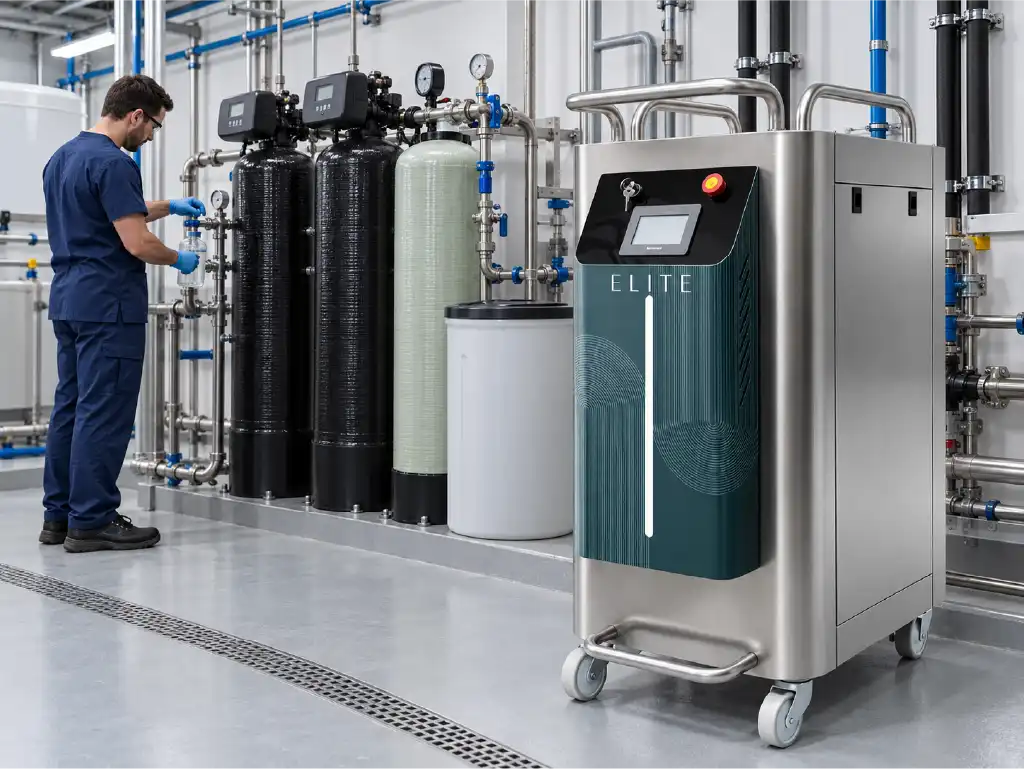
Loop assessment should consider distant outlets, the return line, infrequently used connections and areas reached during disinfection. A satisfactory RO outlet reading does not establish the condition of the entire distribution network. Sampling locations should represent treatment output and relevant distribution points. Circulation, hygienic design and laboratory testing form complementary parts of the control programme.
CDC guidance on water use in dialysis explains the importance of chemical and microbiological quality control. It also includes historical standards, so numerical criteria must be checked against the currently applicable edition. Online trends should be reviewed alongside laboratory results and disinfection records rather than replacing those controls.
How Should Alarm Management Be Planned? Dialysis Water System Alarm Limits in Practice
Start by identifying the hazard associated with each event. Document the parameter, location, threshold, priority, protective action and responsible person. Dialysis water system alarm limits should distinguish maintenance-related warnings from events affecting water suitability or clinical service continuity. A signal with no defined response provides limited operational value.
Standards selection is part of the assessment. The FDA recognition record for ISO 23500-2:2024 identifies the equipment framework, including online quality monitors, and refers ongoing chemical and microbiological purity monitoring to ISO 23500-3. This reference does not replace local legal requirements or demonstrate certification of a particular product.
Collect feedwater results, capacity calculations, the sensor inventory and available alarm history before setting thresholds. Establish baseline data under accepted operating conditions, including relevant demand variations. Dialysis water system alarm limits should provide an appropriate intervention margin before an unacceptable condition while remaining consistent with manufacturer safety functions. A margin is an engineering decision, not a universal percentage.
Warning, critical alarm and automatic protective actions
A warning can identify movement away from the expected operating range and prompt inspection before performance deteriorates further. A critical alarm indicates a condition that may affect safe water delivery or equipment operation. Automatic protection is the specified consequence of that condition. It may involve preventing delivery, diverting product water or protecting a pump, depending on the verified design.
For example, a validated conductivity excursion may require unsuitable product water to be prevented from reaching the distribution system. Low inlet pressure may trigger pump protection. Dialysis water system alarm limits should connect these events to a cause-and-effect matrix showing valve positions, pump actions, notifications and reset conditions. Continued loop circulation must be addressed explicitly where relevant.
Expert note: An abrupt loss of water supply can affect ongoing treatment. The protective response must be validated against manufacturer instructions, the distribution arrangement and the facility’s clinical contingency plan. Local protective functions should operate without relying on an internet connection or a remote recipient noticing a message.
Hysteresis may reduce repeated activation and clearing near a threshold. Any delay requires justification through risk assessment and validation of the transient being addressed. It must not mask a critical quality deviation. Dialysis water system alarm limits should also account for sensor uncertainty, response time and the interval between acquiring a measurement and acting on it.
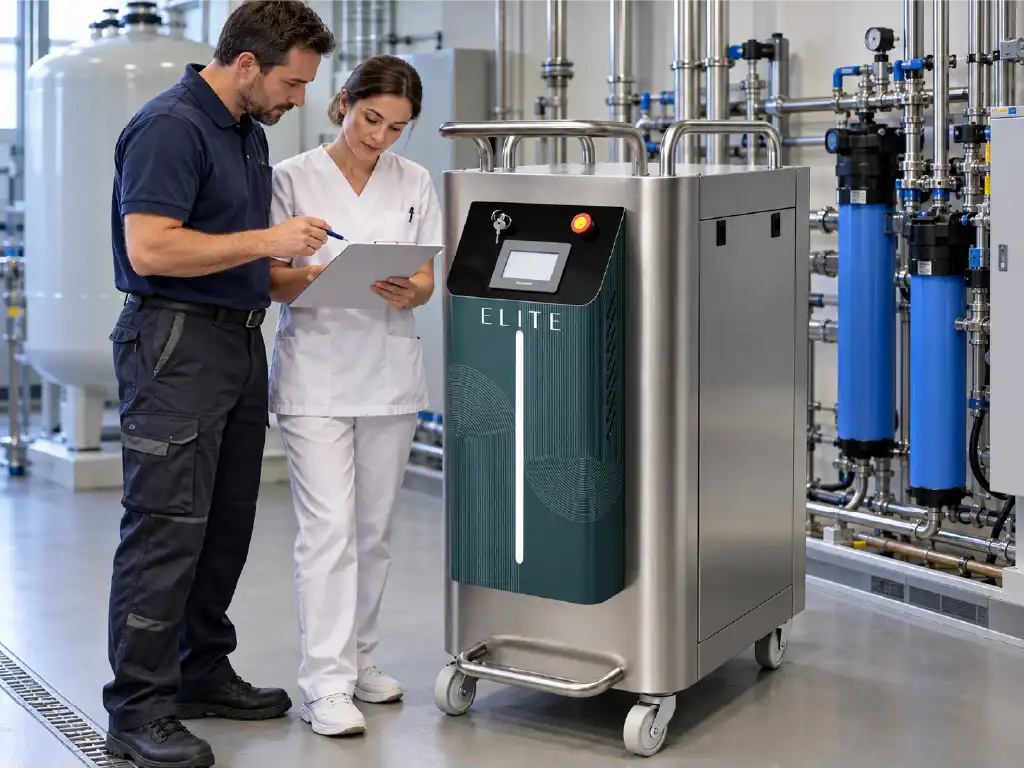
A disconnected sensor, frozen value or communication failure must not be interpreted as a normal quality result. Monitor signal validity and data freshness separately. Check the safe state after power loss and the conditions for restart. Acknowledging an alarm records awareness; it does not establish that the cause has been corrected.
Commissioning should test threshold activation, local notifications, protective outputs and return-to-service conditions using a safe test mode. Do not introduce faults during patient treatment. Evaluate production, standby and disinfection separately. Repeat relevant verification after changes to software, instruments or hydraulic components, and retain the results in the technical documentation.
A worked scenario can expose gaps. If product conductivity rises, review signal validity, incoming-water changes and operating mode while the defined protection acts. Notify the clinical lead through the facility procedure. Investigate instrumentation, connections and membrane performance separately. Dialysis water system alarm limits should lead to documented acceptance checks before delivery resumes; a disappearing alarm is not sufficient closure evidence.
Alarm records, notification escalation and operator intervention
Records should identify when an event began, which equipment was involved and what happened next. Include the measured value, unit, active threshold, operating mode, acknowledgement time and corrective action. When dialysis water system alarm limits change, preserve the previous setting, the revised setting, the reason and the authorised approver.
Notification planning needs more than a message recipient. Define the first responder, technical escalation route and conditions requiring clinical involvement. Message delivery and completed assessment are different milestones. Provide a backup contact and alternative communication route when the primary responder or notification service is unavailable.
Dialysis water system remote monitoring can support trend review and technical assessment where it is specified and validated. Its availability should be confirmed for the selected project rather than assumed for every Reinmeer model. Dialysis water system alarm limits must remain enforced locally. Access permissions, connection status and setting changes should be recorded and controlled.
The time of the last valid measurement should be visible wherever remote values are displayed. Synchronise clocks so maintenance, sampling and alarm events can be compared meaningfully. Make data gaps explicit. Determine retention through the quality system and protect records from unauthorised changes or loss. A stale dashboard is not evidence of normal operation.
Operator instructions should specify suitable verification checks, communication responsibilities and permitted actions for each event. Suspected water-quality problems require the approved facility response. Repeated events should prompt root-cause investigation rather than repeated silencing. Where appropriate, maintenance and technical support can help assess instruments, connections and equipment condition.
Training should demonstrate who checks the measurement, who contacts the clinical team and who authorises return to service. At shift handover, communicate unresolved events and pending test results. Periodic review should assess event severity, response effectiveness and recurrence. Widening a threshold without investigating the cause may conceal deterioration.
Frequently Asked Questions
Is there one conductivity setting for dialysis water system alarm limits?
No universal equipment setting should be copied between facilities. Consider applicable water-quality requirements, feedwater characteristics, verified treatment performance, instrument uncertainty and manufacturer instructions. Conductivity is a useful indicator, but it does not demonstrate compliance with every individual chemical or microbiological criterion.
Can a conductivity alarm detect chloramine breakthrough?
It should not be treated as a reliable chloramine test. Carbon-stage performance requires an appropriate chlorine or total-chlorine method with sufficient sensitivity and representative sampling locations. The facility procedure must identify what the method measures, how results are interpreted and which acceptance criteria apply.
Does online monitoring replace laboratory testing?
No. Routine conductivity, pressure and flow sensors do not directly measure bacteria or endotoxin. Continue the chemical and microbiological testing programme required by applicable standards and local requirements. Online data complement that programme by helping identify changes and establish when a process disturbance occurred.
Can the system restart immediately after an alarm is acknowledged?
Acknowledgement confirms that the event has been seen. Restart requires correction of the cause, appropriate verification and any additional testing or disinfection specified by the approved procedure. Define decision authority and acceptance evidence in writing, consistently with manufacturer instructions and the facility’s clinical responsibilities.
Can remote monitoring replace local alarms?
No. Local protection must remain effective when connectivity or message delivery fails. Validated remote access can support technical assessment, but permissions must be restricted. Record setting changes and use authorised review for critical adjustments. Confirm available functions during project selection rather than assuming a standard feature set.
Review Your Monitoring Plan with Reinmeer
A useful alarm plan connects credible measurements with protective actions, accountable intervention and verified return to service. If you need to establish dialysis water system alarm limits for a new facility, review an existing installation or investigate recurring events, discuss your requirements with Reinmeer Water Treatment Systems. Feedwater results, capacity, distribution drawings and available alarm records provide a practical starting point.
Explore Reinmeer hemodialysis water treatment solutions and request a project assessment or quotation. The discussion can clarify monitoring locations, pretreatment checks, maintenance needs and the feasibility of any requested remote functions. This creates a defined scope based on site conditions rather than a settings list copied from another centre. For upgrades or new installations, agree the necessary verification, operator training and periodic review steps alongside the equipment requirements.
Görseller temsilidir ve yapay zekâ kullanılarak oluşturulmuştur.